.jpg)

* ongoing
(2025)
the promised river

For nearly two centuries, the São Francisco River has occupied Brazil’s political imagination as a possible answer to water scarcity in the Northeast. The idea of diverting its waters into the semi-arid interior dates back to the Empire and survived successive governments before taking concrete form in the early twenty-first century. Construction began in 2007, and the São Francisco River Integration Project has since become the largest water infrastructure project in the country: 477 kilometres of canals along its North and East axes, connected to reservoirs, aqueducts, tunnels and pumping stations. More than R$14 billion has been invested in a project conceived to improve water security for around 12 million people across approximately 390 municipalities in Pernambuco, Paraíba, Ceará and Rio Grande do Norte.
Water, however, was never absent from this territory. It has always arrived and remained according to different measures of time: perennial rivers that endure, intermittent ones that recede and return, ephemeral streams that emerge with the rain and disappear again. Around these rhythms, reservoirs, wells and cisterns have shaped ways of living with water as both presence and uncertainty. The São Francisco introduces another temporality into this geography. Rather than bringing water to a place where there was none, the diversion changes the conditions of its presence — how it circulates, how regularly it returns and, above all, the expectation that it might remain. A new infrastructure now crosses much older relationships with land, labour, migration, memory and desire.
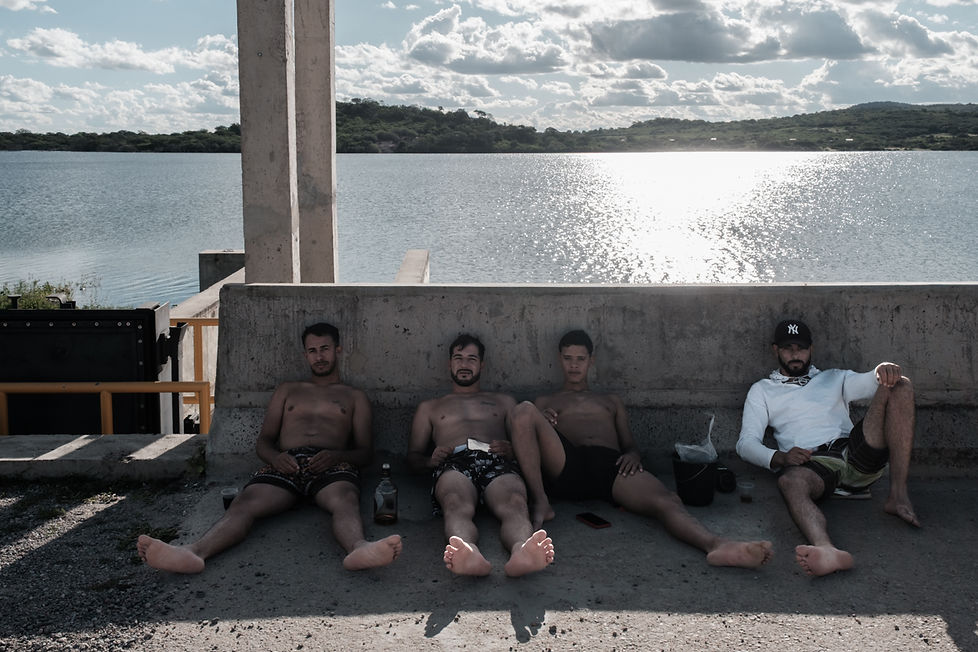
At first, the engineering itself seemed to dominate the visual field: the geometry of canals cutting through the Caatinga, the scale of concrete structures, the presence of water moving through an engineered landscape. Gradually, however, the infrastructure began to recede from the photographs without necessarily receding from everyday life. Its presence could be felt elsewhere: in fields, homes, gestures, forms of work, expectations and new ways of occupying the land.
That shift also raises questions about representation. The Northeast has been shaped by a long history of images and narratives around drought, migration, scarcity and resistance. These themes run through Brazilian literature, cinema, photography, journalism and social thought, and have helped define how the region has been seen, both from outside and from within. If material conditions begin to change, the images used to describe the region may also need to change. What once appeared to define a landscape, a body or a way of life may no longer be enough.
The work does not seek to prove the success or failure of the diversion, nor to attribute every transformation to the arrival of water. Some changes are already visible: irrigated land, new crops, different flows of goods and new possibilities for work. Others are less clear and may take years to become fully visible. The same infrastructure may create opportunity in one place, remain distant in another, reinforce older inequalities or open paths that are still difficult to anticipate.
For this reason, the project is less concerned with a simple before-and-after narrative than with the relationships forming around the work. Bodies, animals, machines, houses, beliefs, labour and landscapes continue to carry older histories while entering new arrangements. Some things remain. Others change function. Others simply acquire the possibility of changing. Ways of staying, leaving, working, remembering and imagining the future may shift before those changes can be measured.
Photography stays close to that uncertainty. Between what is already visible and what is still unfolding, the diversion becomes more than an engineering project: it begins to reshape a material and imaginative landscape. What is at stake is not simply the arrival of water, but what a more stable relationship with it may make possible over time.
What may be taking shape is not a new image of the sertão, but the growing impossibility of any single image remaining sufficient to define it.